

By: Roberto Rosenman

(Figure 1) Gustav Klimt, Judith 1. (1901) Oil on Canvas, Austria National Gallery.
The femme fatale became one of the most popular subjects for Austrian artists at the end of the century. Drastic shifts in Vienna’s social and political life, from an influx of immigration to urban centres to the opening of art schools to female students, culminated in both real and imagined threats to the patriarchy. On the one hand, the femme fatale became an allegory for the threat of syphilis while simultaneously symbolizing male anxieties surrounding women’s struggle for independence and suffrage. At the same time, the predominance of this archetype demonstrates the crisis of the ego in a society where Freud’s theories of sexual repression and dreams were gaining traction. As historian Lisa Fisher succinctly puts it, “The crisis of the ego, was the crisis of the male figure”.[1]
As a painter of women, Klimt’s work has often aligned with the misogynistic depictions of female sexuality of contemporary Symbolist artists like Gustav Moreau (1826–1898) and Franz von Stuck (1863–1928). To quote one such example, author Eric Kandel states, “Klimt’s Judith is true femme fatale: She evokes in men both lust and fear: and she obtains pleasure from both.”[2] Statements like these ignore the complexity of Klimt’s work, which breaks the alliance with the femme fatale tradition. While female sexuality was certainly a source of inspiration for Klimt, Klimt’s depiction of the female fatale in Judith 1 is unique from that of his contemporaries. (Fig. 1) Contrary to being merely a symbol of threatening erotic pleasure, Klimt uses both ornament and a linear flattening of form to subvert the traditional archetype of the femme fatale. In doing so, Judith 1 is not merely a crisis of the ego but a metaphor for female identity, the tension between historicism and modernism, and racial ideology in contemporary Austrian society.
Paintings depicting Classical mythological figures flourished in the late 19th century as artists were encouraged to draw from these archaic sources within the academy. Certainly, Klimt was not immune to this influence and regularly drew from these sources in his early paintings like Sappho (1888) and Portrait of Pianist Joseph Pembauer (1890). (Fig. 2,3) Beginning in 1897 and coinciding with his growing frustration at the emphasis on historicism within the academy, Klimt began to use these symbols as a tool for subversion to highlight the struggle between historicism and modernism. In his poster for the first Secession exhibition, an image of Theseus slaying the minotaur stands for the Secessionist’s victory against the Kunstlerhaus Genessenschaft, Vienna’s private exhibiting society founded in 1861. Known for its staunch emphasis on historicism, the society increasingly favoured naturalistic painters while rejecting modernists and impressionists. When arch-conservative painter Eugene Felix was appointed to the board of directors of the Künstlerhaus in 1896, Klimt and a like-minded group of breakaway artists announced their resignation from the academy and officially created their group, the Vienna Secession, in 1897. The name of their journal, Ver Sacrum and the illustration of a blossoming tree breaking out of its container on the inaugural issue was a reference to the liberation of youth from their elders in Polis; again, another jab at the Kunstlerhaus. (Fig. 4,5)
-
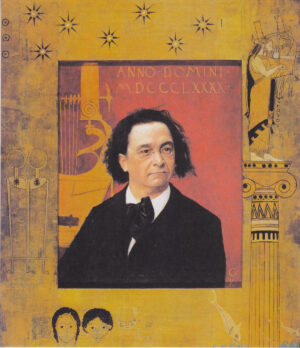
- (Figure 2) Gustav Klimt, Portrait of Pianist Joseph Pembauer (1890)
-

- Figure 3) Gustav Klimt, Sappho (1888)
-
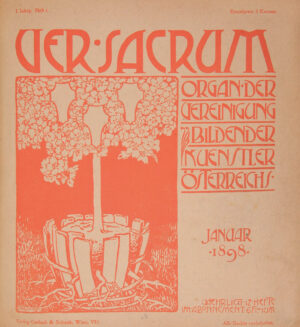
- (Figure 4) Ver Sacrum, Issue 1 (1897), Illustration by Alfred Roller
-
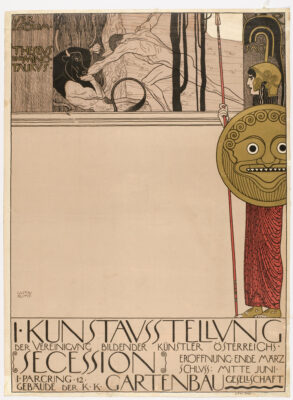
- Gustav Klimt, Poster for first Vienna Secession Exhibition (1897)
In Judith 1, Klimt again subverts the classical story of Judith and Holofernes by emphasizing the heroine’s erotic powers rather than her piety. The story of Judith recounts the story of a pious widow who, to save the city from the Babylonian Assyrian forces, seduces Holofernes and decapitates him while he sleeps. On the one hand, Klimt’s Judith breaks with the tradition of depicting her as a pious virgin ashamed of her deed. In contrast to Caravaggio’s Judith, who is ashamed and repulsed by the deed, in Klimt’s version, Judith’s half-closed eyes show her relishing in the act, suspended in a moment of erotic ecstasy seemingly derived from the murder rather than the seduction of Holofernes. (Fig. 6) At the same time, historian Erwin Panofsky has highlighted how viewers would have identified depictions of Judith through distinct iconographic strategies and elements. While portraits of Judith and Salome shared the image of the decapitated head, the presence of the sword and omission of the charger would have helped viewers differentiate between Judith as a pious virgin and the corrupt and ravenous Salome who embraces her sexuality and destructive powers. Klimt’s depiction of Salome (1909), painted 8 years later, also omits the key iconography of the plate and charger. (Fig 7) In contrast to Judith’s expression of erotic ecstasy, it is Salome who appears emboldened and rational, seemingly embodying the virtues of the pious Judith. It is therefore unsurprising that this painting was mislabelled, often referred to in catalogues as ‘Judith 2’.
-
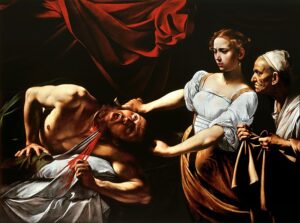
- (Figure 6) Caravaggio, Judith Beheading Holofernes (1599)
-
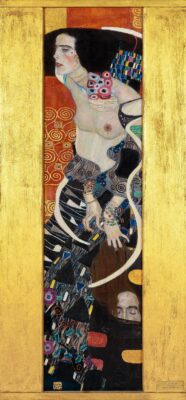
- (Figure 7) Gustav Klimt, Salome (Judith II) (1909)
Reviews of Klimt’s painting at the time reveal how critics and the public repeatedly conflated Judith 1 for Salome. In a 1901 review of Wiener Zeitung, the author states, “She is much more Salome than Judith. The heroine is missing—Judith wasn’t a belle, Salome was”.[3] In the Munich-based journal Die Kunst (Art), critic Fritz von Ostini reiterates this sentiment, writing, “Klimt shows his rich decorative taste in … a Judith, which would actually be better identified as Salome.”[4] In turn, a 1912 issue Die Kunst fur Alles, devoted entirely to the work of Klimt, shows the title Judith beside a colour plate reproduction of the work. This catalogue of commentary sheds light on the confusion among viewers of Klimt’s reworking of well-known iconography. Yet, not all critics failed to see Klimt’s motives behind the blurring of the two female figures. The art critic Felix Salten (1869-1945), an ardent supporter of Klimt and the Vienna Secession, applauded Klimt’s reworking of signs in the picture in a review of the 1901 Secession exhibition, writing:
“This woman, who carries the head of Holofernes in her hand, does not correspond to the general idea one has of Judith. Of course, such general conceptions only came about through a myriad of statues and embodiments that were essentially similar to each other so that in the course of time, everyone could recognize a painted Pallas or a painted Judith without the help of the artist. In fact, everyone already has a very specific visage in his head when he thinks of Pallas or Judith. But it would be a bad thing if these ingrained ideas were to have the validity of laws for the artist? The way in which one usually thinks of a Pallas or a Judith, of course, represents the average of all the portraits we have seen of them so far. Characteristics and the particular conception of individual masters are blurred in this tradition, dissolved into attributes and recognizable signs. That would be a boring artistic commandment, according to which the modern artist would have no other choice but to vary these long-established signs.”[5]
Klimt, for his part, was aware of the confusion, so much so that he commissioned his brother Ernst to create a frame for the painting bearing the title ‘Judith and Holofernes,’ his refusal to let the misnomer slip further evidence of his intention to subvert the story. In reversing the narrative and making the pious Judith a femme fatale, Klimt highlights the changing role of women in society. In blurring the boundaries between two Judeo-Christian symbols of femininity, Klimt’s Judith becomes a metaphor for the New Woman in Fin de Sieclé Austria, ultimately becoming a pro-feminist picture.
The New Woman represented the desire for access to higher education and the right to work, eventually culminating in the suffrage movement. Although the emancipation movement in Austria was relatively subdued compared to its English and American counterparts, Austria had a higher percentage of women in various types of employment. Compared to the US (23%) and England (37%), Austrian women comprised 55% of the country’s workforce.[6] The majority of these women were employed in proletariat-type work, a testament to the thousands of largely poor foreigners who had come to Vienna during the population boom of 1870–1910. This shift in women from the domestic sphere to the workforce would have undoubtedly contributed to the view by conservatives that women and foreigners were responsible for the breakdown of traditional social structures.
Women also played a pivotal role in the artistic life of Vienna, thanks in part to early reforms in education, which saw Austrian women being granted the right to study earlier than other European capitals. The appointment of Vienna Secession founding member Felician von Myrbach as the director of the Applied Arts School of Vienna (Kunstgewerbeschule) in 1899 resulted in the hiring of key Secessionist artists Koloman Moser, Alfred Roller and Josef as teaching staff. In addition, the hiring of female instructors, such as Leopoldine Guttmann and Rosalie Rothans, led to a further increase in female enrollment. While Klimt did not formally teach at the school himself, he was an ally of women and supported their involvement in the arts. Although women were not formally allowed membership in the Vienna Secession due to Austrian laws, they were regularly invited to exhibit and were included in their programs. Klimt also supported his lifelong companion Emile Flöge—a fashion designer and businesswoman who opened an exclusive fashion house with her two sisters in 1904 and whose modern Viennese fashions encouraged Viennese women to ditch their corsets. The Wiener Werkstätte, the commercial offshoot of the Vienna Secession formed in 1903, employed 180 female artists who contributed designs to their postcards, fashion, and ceramics.
Klimt’s decision to reverse the archetype of the femme fatale can be viewed as a response to his contemporaries, Stuck and Moreau’s depictions’ of Salome as a bloodthirsty mad woman, which played on society’s fears that if women abandoned the responsibilities of domesticity and motherhood, men be required to fill this role and ultimately become feminized.
If critics were perplexed by Klimt’s blurring of Judith and Salome, they would have equally been bewildered by his fusing of naturalism and ornament. Nearly half of Judith’s body is covered in ornamental motifs drawn from Assyrian art. Klimt had been raised in an environment steeped in the decorative arts. His father, a gold engraver, influenced the young Gustav Klimt and his younger brother Ernst, who worked alongside him as a painter and decorator of Ringstrasse buildings, earning the prominent commission for staircase panels at the Imperial-Royal Court Museum.
Debates on the role and function of ornament occupied a significant position in 19th-century Germany. At the forefront of these debates was Alois Riegl (1858-1905), whose monumental work Problems of Style: Foundations for a History of Ornament (1893) traced the development of ornamental motifs in various cultures and sought to show how ornament developed independent of its form and structure. He dismissed the theories of architect Gottfried Semper, who made a distinction between Kernform, the tectonic structure of the building, and the Kunstform, an object’s outer shape and appearance, all the whilst elevating architecture as the highest art form. In contrast, Riegl argued for ornament as being an autonomous entity that developed independently throughout history and was not bound to any external considerations. Ornament, he wrote, follows “the same continuous, coherent development that prevails in the art of all periods, as in the historical relationship between antique mythological imagery and Christian iconographic types.”[7] Through this radical position, Riegl sought not only to free ornament from its symbolic and materialistic associations but to elevate it to the same status as figuration. In challenging the hierarchal structure that was rife in the art academies of the 19th century, he suggested that abstract ornament, and in turn, the applied arts, were equal in value to fine arts and painting and, therefore, should be considered worthy of serious scholarship.
As Riegl was writing Stillfragen, the Jugendstil movement (Germany’s version of Art Nouveau) was slowly fermenting in Germany and Austria, soon to explode a decade later into an ornamental style that used abstraction as a reaction to historicism. For his part, Klimt was familiar with Riegl’s theories and began experimenting with ornamentation in his paintings as early as 1893. Though restrained in relation to the rich ornamentation of his later work, we see ornament creeping into his portraits of women, first as strategically placed props such as the hanging wall carpet Portrait of a Woman (1894) and then as wall motifs as evident in Portrait of a Lady (1894). (Fig. 8,9) Although these early works might show the early rumblings of dissent from his position as a Ringstrasse painter, Klimt primarily used ornament in this period as a stylistic device rather than as a tool of subversion. The Japanese pavilion in the World Fair in Vienna in 1873, commemorating the 25th anniversary of the reign of Emperor Franz Joseph, introduced Klimt to Japanese woodblock prints whose distinctive flattening of form and use of contour lines had a profound influence on Jugendstil graphic art, and likely influenced the side panels in his painting Love (1895). (Fig. 10)
-
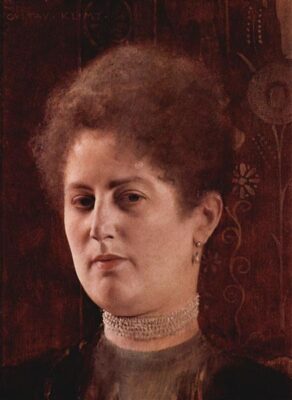
- (Figure 8) Gustav Klimt, Portrait of a Lady (1894)
-
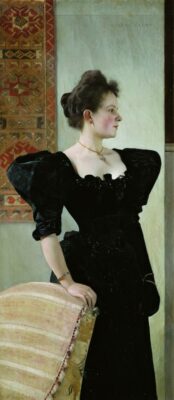
- (Figure 9) Gustav Klimt, Portrait of a Lady (1894)
-
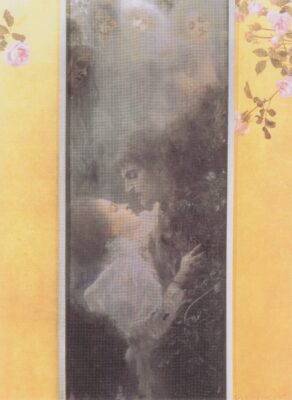
- (Figure 10) Gustav Klimt, Love (1895)
Perhaps the most seductive of Riegl’s theories for Klimt was his concept of Kunstwollen, which came to represent a model for the Vienna Secession. Translated as ‘artistic volition, or the will of art, Kunstwollen represented the ‘spirit’ of the artist’s will, driven by psychological rather than materialist forces. The term was intentionally nebulous, but it was precisely its broad inclusiveness which allowed it to encompass the aesthetic, cultural, and structural qualities of an object, regardless of its status as high or ‘low art.’ According to Riegl, ornament represented the truest essence of the Kunstwollen as it represented artistic freedom. For Klimt and the Secessionists, Riegl’s Kunstwollen aligned with their vision of an art that reflected their cultural age, and they promptly incorporated it into their motto (penned by art critic and writer Ludwig Hevesi) on the inscription of their new Secession building, ‘To every age its art, to every art its freedom.’
At the same time, Riegl’s Kunstwollen aligned perfectly with their philosophy of art as a Gesamtkunstwerk (a total work of art) which sought to break the hierarchal distinction between graphic and fine arts. For Klimt, the Secession not only became a temple of artistic freedom but also the fulfilment of a new way of looking at ornament beyond merely a decorative device. If ornament and graphic design were to be elevated to the status of the high arts, they would have to be disengaged from their materialistic and naturalistic associations and take on a deeper and more significant role.
While Klimt’s use of Assyrian ornamental patterns and gold paint in Judith 1 could be read as an attempt to draw from non-European influences, he was keenly aware of how ornament could serve as an iconographic symbol for sexual impulses. Historian Kirk Vanerdoe sees this as a nod to Reigl’s theory in that “The kind of confusion and ornamental richness does not embellish the content of Klimt’s art, it is the content.” [8] Klimt’s use of gold likely came from his encounter with Byzantine mosaics in Ravenna and Venice in 1903, and he would have been aware of the religious association of gold with purity and the eternal realm. In this sense, the gold in his Judith 1 transforms her from a symbol of impurity to a “sacred icon of womanhood.”[9] Ornament repeatedly interrupts the viewer’s consumption of Judith’s nakedness, likely an annoyance to male art spectators who would have been accustomed to the display of full nudes in the Academy. Klimt conceals her left breast behind a veil of black and gold fabric mimicking the partial view of Holofernes’ severed head concealed at the edge of the frame. Most apparent is the gold cloisonné choker, which symbolically decapitates Judith much in the manner of Holofernes.[10] This is further heightened by the repetition of the choker’s pattern on the band beside Holofernes’ head. We, therefore, encounter another clever reversal here by Klimt: it is Judith who has been dismembered and fragmented by lust and desire. One might extend this reversal further by suggesting that Judith’s half-closed eyes and parted lips are not indicative of erotic ecstasy but rather her dying gasps. This fragmentation of his female subjects reached its climax in the ‘golden’ period of Klimt’s portraits between 1906-1909, culminating in the most extreme in his Portrait of Adele Bloch Bauer (1907), which was frequently satirized in editorial cartoons from the period. In one satirical cartoon mocking the 1908 Kunstschau exhibition from the satirical magazine Die Muskette, we see several of Klimt’s paintings as the subject of ridicule, including the Portrait of Adele Bauer. Renamed ‘Frau A, B, C, D,’ she is being assembled (or disassembled) with a hammer and screwdriver. (Fig.11, 12)
-
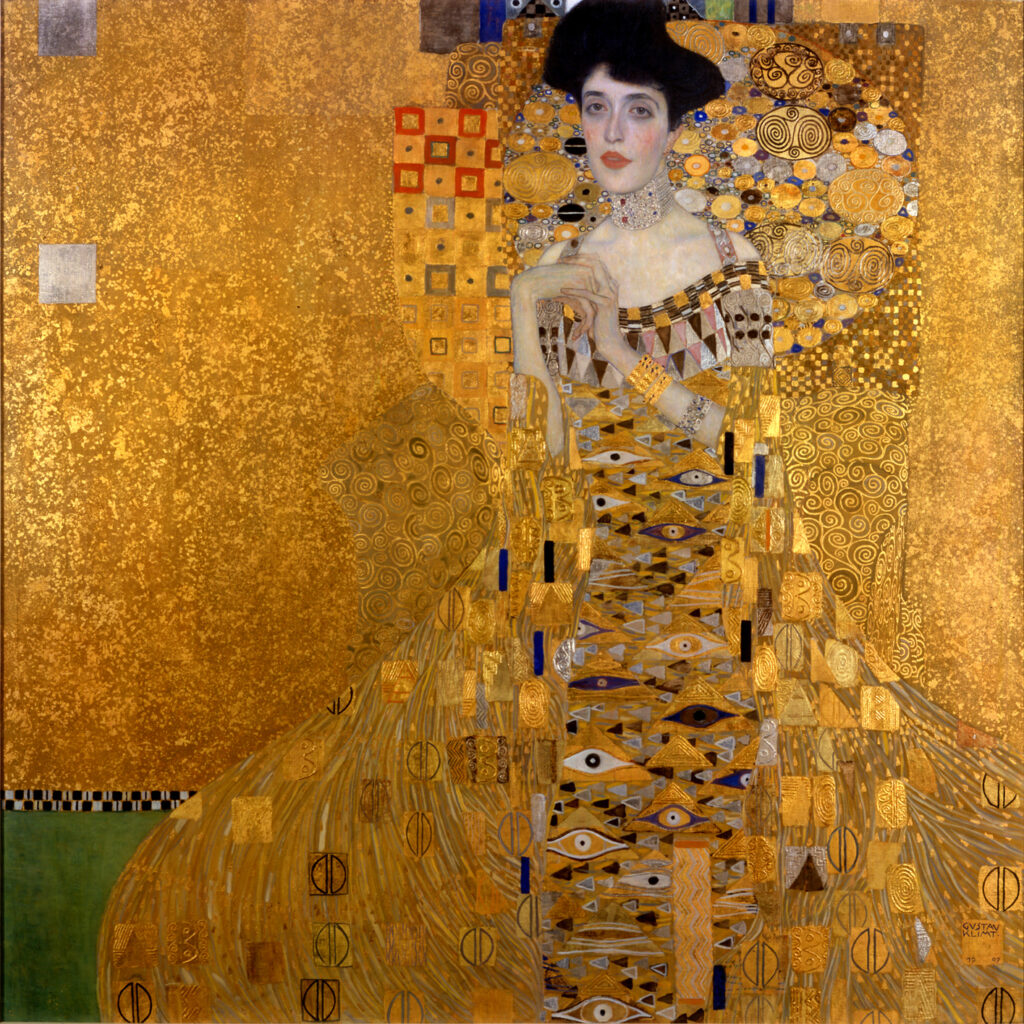
- (Figure 11) Gustav Klimt, Portrait of Adele Bauer (1907)
-
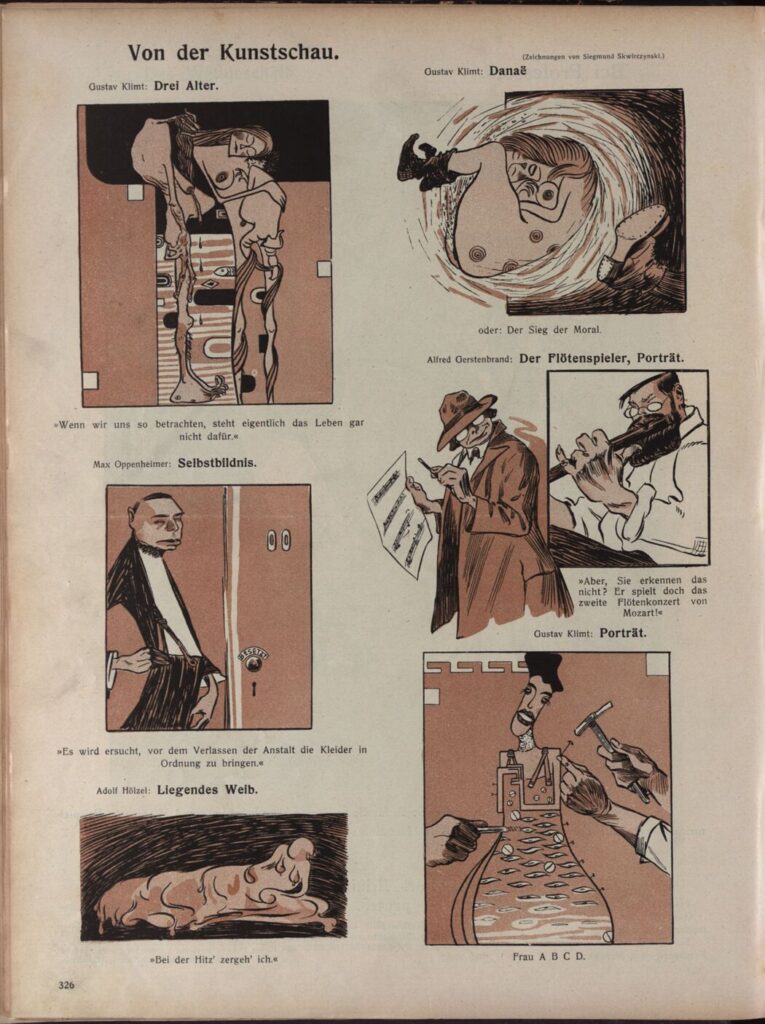
- (Figure 12) Artist Unknown, In the Kunstschau. Illustration in Die Muskette, 2 July 1908.
By intentionally blurring the boundaries between eros and death, Klimt’s work becomes a metaphor for the tension between rationalism and the instinctual. In addition to attacking the historicism within the academy, Klimt uses classical symbols to explore the instinctual and sensory pleasures which had begun to be examined in modern society. Historian Carl E. Schorske aligns Klimt’s project with Freud’s interest in drawing parallels between sexual repression and a ‘sickened’ society. He writes: “Klimt uses classical symbols to serve as a metaphorical bridge to the excavation of the instinctual, especially of the erotic life. The erstwhile social painter of the Burgtheatre became the psychological painter of women.”[11]
In exploring the instinctual, Klimt again uses ornament and a graphic flattening of form to signal a move away from rationalism towards the world of the subconscious and sublime. Ultimately, this becomes a metaphor for the synthesis between Dionysian and Apollonian forces, which Nietzsche believed formed the arts. For Nietzsche, Dionysus is associated with irrationalism, the primordial, ecstasy, chaos, the abstract, and most importantly, the erotic instincts, while Apollo evokes rationalism, harmony, logic, the organic, naturalism, and the sublimation of the erotic instincts. For Klimt, ornament, therefore, represents a return to the instinctual and primordial impulses of the natural world and a celebration of the Dionysian urge, much in the same way that Riegl saw it as an embodiment of Kunstwollen; “All art, and that includes decorative art as well is inextricably tied to nature.”[12] Klimt’s Judith is being consumed by pattern, signalling her descent into the realm of primordial sensual pleasure. In The Beethoven Frieze, perhaps his most psychological work, pattern is unleashed in the last panel where the male figures surrender to the instinctual, irrational, and primitive force of erotic pleasure of his femme fatales. (Fig 13) In its bare flatness, evoking the linear wall paintings of Egyptian goddesses, Klimt’s frieze oscillates between fine and graphic arts, much in the same way that his solemn waifs struggle in limbo between rationality and sensory pleasure.

(Figure 13) Gustav Klimt, The Beethoven Frieze (1902)
It is not a coincidence that Klimt devoted himself, particularly in his later years, to painting women and landscapes. The natural world represented, on the one hand, a refuge from the rapid urbanization of Vienna, but also, in its untamed and pure state, the ideal representation of the Dionysian forces. By aligning the female figure with the natural world, Klimt ultimately makes a statement on the struggle for female identity and independence. Historian Iiona Sarmany Parsons sees Klimt’s link of femininity with the natural world as an intentional strategy to free women from the misogynistic depictions of his contemporaries. She writes, “There is no sign that Klimt despises women, desires to humiliate them, or regards them as hostile beings. To him, woman is part of the natural world, a fragment of the infinite continuum that is the stream of life, a passive element in nature. Thus, women, in contrast to men, who are never represented as lost in the ecstatic moment, are much closer to nature itself.”[13]
The influence of Jugendstil contributed to Klimt’s stylistic shift to a linear and flattening of form. While, on the one hand, this represented a blurring between the graphic and fine arts, its use by Klimt takes on a secondary role in aligning the femme fatale with the pathological body, whereby disease and ugliness represent Jewishness and modernity.
While members of the Jewish community rose socially in society, antisemitism remained very much the cultural wallpaper of Fin de Sieclé Vienna, fueled in part by the populist and virulently antisemitic Karl Lueger (1844-1910), Vienna’s mayor from 1897-1910. The majority of Klimt’s clientele and backers belonged to prominent upper-class Jewish families such as the Wittgensteins (which included the young Ludwig), the Bloch-Bauers, and the Lederers. Although Klimt was not Jewish himself, this association earned him the nickname ‘Jewish Klimt’ in the conservative press. Despite the high number of women in proletariat jobs, it was predominantly upper-class Jewish women who promoted modernism and challenged traditional views of domesticity through the establishment of Salonierres, female informal ‘clubs’ where they were free to interact and discuss topics normally considered unacceptable. Thus, the threat of ‘feminization’ and ‘Judaization’ became synonymous with those who saw modernism as being responsible for the breakdown of traditional social and family structures.
Anti-Semitic beliefs about the diseased and grotesque Jewish body and mind became a common narrative in Fin de Sieclé Vienna among biologists and anthropologists who sought to show a direct line between Judaization and the rising spread of sexually transmitted diseases. These theories gained traction not only from non-Jewish writers but also among Zionist Jewish writers who rallied against assimilation by the Jewish Diaspora or those who had converted to Christianity. The Austrian physician Ignaz Zollschan (1877-1944) argued for the purity of the Jewish race and was strongly opposed to marriages between Jews and non-Jews. He also attributed an increased incidence of mental illness among diaspora Jews to high rates of syphilis rather than as a result of inbreeding. “The syphilitic infection first began as a result of assimilation and became epidemic among the Jews.”[14] In turn, the philosopher Otto Weininger (1880–1903) argued against the progressive feminization of Viennese culture in his highly popular work Sex and Character (1903), in which he linked the emergence of the Jewish upper class to the breakdown of social and family structures. Weininger associated everything negative with femininity and Jewishness and linked the excessive ornamentation and decadence of Viennese culture as evidence of this breakdown. [15] As a Jewish homosexual, his work gained traction among conservative Viennese society, who were eager to find fodder to support their antisemitic and misogynistic ideologies.
For viewers familiar with these popular ideologies, Klimt’s Judith comes to epitomize the Jewish pathological body. Judith and Salome are both Jewish female figures who simultaneously represent the hyper-feminized and diseased body. Historian Nathan Timpano argues that Klimt’s rendering of Judith is an intentional strategy to subvert the narrative of a pathologically sexualized figure. Timpano highlights Judith’s physiognomy, such as her noticeable drooping left eye as a sign of Ptosis and her highlighted left front tooth as a physical defect attributed to either a dental malocclusion or Fluorosis. With this latter defect, he argues, Klimt has created the quintessential pathological Femme Fatale by giving his Judith a fang.[16]
When considered in the context of Klimt’s own life, one can view the concept of the diseased Jewish body as a trope to represent modernity. While working on Judith, Klimt suffered a personal blow with the negative reception of his commissioned three paintings, Philosophy, Jurisprudence, and Medicine (1900-07), for the University of Vienna. The project saw major opposition from both faculty members and the public, who petitioned to reject the works. Unsurprisingly, critics singled out the diseased bodies in Klimt’s Philosophy and Medicine as evidence of its ugliness. Ultimately, Klimt backed down and purchased the paintings from the Ministry of Culture, but the scandal marked a turning point in his life as he withdrew from public life and devoted himself exclusively to painting female portraits and landscapes.
In 1909, The Klimt Group held the Kunstschau exhibition, which included emerging expressionist painters. Among them were Oscar Kokoschka (1886–1980) and Egon Schiele (1890–1918), two young emerging artists who had been mentored by Klimt and had adopted his linear style. Yet this is where their kinship ended. With contorted bodies in aggressively sexual poses, Kokoschka’s and Schiele’s depiction of female sexuality was even more aggressive than those of Klimt’s early contemporaries. Unlike Klimt, Kokoschka and Schiele ignored the use of allegory and ornament, preferring to insert themselves in a dramatic struggle between the sexes. The crisis of the male ego had returned with a vengeance, and with it, the trope of the menacing woman.
© Roberto Rosenman, 2025
Notes
[1] R. Schmidt, “Gender Asymmetries in Viennese Modernism.” Klimt’s Women. (London: Yale University Press, 2000), 32.
[2] Eric R. Kandel, The Age of Insight : The Quest to Understand the Unconscious in Art, Mind, and Brain : From Vienna 1900 to the Present. 1st ed., (Random House, 2012), 121.
[3] Author Unknown. “Short Chronicle”. Wiener Zeitung, April 1, 1901. (Except where noted, this and other translations from the original German into English were generated by DeepL and edited by the author.)
[4] Fritz von Ostini, “Die VIII. Internationale Kunstausstellung im KGL Glaspalast zu München”, Die Kunst, 3, 1900–01, 84.
[5] Felix Stalen,. “Secession: Der Hall Klimt.” Wiener Allgemeine Zeitung, April 14, 1901. 2.
[6] Jill Lloyd “The Viennese Woman: A Community of Strength” Klimt and the Women of Vienna’s Golden Age, 1900-1918. Prestel, 2016. 17
[7] Alois Riegl, Problems of Style: Foundations for a History of Ornament, trans. Evelyn Kain and annotated by David Castriota (Princeton, 1992) 8.
[8] Kirk Varnedoe, Vienne 1900: Art, Architecture, and Design. (The Museum of Modern Art, 1986), 158.
[9] Daniela Hammer-Tuggendhat, “Judith.” Klimt’s Women. (London: Yale University), 23.
[10] Judith’s choker is nearly identical to the one worn by Adele Bloch Bauer for her 1907 portrait by Klimt and likely produced by Josef Hoffmann for the Wiener Werkstätte in 1903. If it is indeed the same choker, it can be traced to Nazi second-in-command Herman Goering who plundered Bauer’s art collection and jewellery. In a sinister twist of fate, the choker did end up around the neck of a real-life femme fatale when Herman Goering gifted it to his wife, Emmy Goering. Author Anne-Marie O’Conner’s book The Lady in Gold offers a harrowing account of the plunder of Bloch-Bauer’s art collection and the fate of her jewellery.
[11] Schorske, Carl E. Fin-de-Siecle Vienna : Politics and Culture. 1st Vintage Book ed., Vintage Books, 1981. 223.
[12] Riegl, Problems of Style, p.14
[13] Sármány-Parsons, Ilona. “The Image of Women in Painting: Clichés and Reality in Austria-Hungary, 1895–1905“. Rethinking Vienna 1900, edited by Steven Beller, New York, Oxford: Berghahn Books, 2001. 226
[14] Rose, Alison. Jewish Women in Fin de Siècle Vienna. 1st ed., University of Texas Press, 2008. 173
[15] Ibid. 175
[16] Nathan J. Timpano, (Nathan James). Constructing the Viennese Modern Body : Art, Hysteria, and the Puppet. 1st ed. (New York: Routledge, 2017), 112.