
At the turn of the 20th century, Vienna stood as Europe’s unchallenged capital of grand social fêtes—especially its legendary balls and redoutes (Masked Balls). These lavish gatherings were more than social evenings; they reflected the city’s cultural aspirations, political alliances, and artistic revolutions. Artists associated with the Vienna Secession and Wiener Werkstätte actively participated in the balls, from hosting them in their museum building to designing keepsakes and advertising materials. Their role contributed to the balls becoming a complex interplay of tradition and modernity.
The Redouten & the Hofburg’s Courtly Legacy
The tradition of redoutes—classic masked balls—was deeply embedded in Viennese court culture. The term “redoute” itself derives from the French for a masked ball, which became a staple of Imperial social life. In the mid-18th century, Maria Theresa ordered the remodelling of two Baroque theatres within the Hofburg into the Redoute Rooms—large and intimate ball spaces designed for society’s gatherings.
By 1748, masked carnival season redoutes were held annually, accommodating up to 3,000 Viennese. By the Congress of Vienna (1814–15), the Hofburg’s Redouten-Saal was the epicentre of Europe’s aristocratic revival—inspiring the famous pun, “Le Congrès danse beaucoup, mais il ne marche pas” (“The Congress dances a lot, but it does not walk”) Engravings by Wilhelm Gause and Vinzenz Katzler immortalize the grandeur of these events. Monarchs, courtiers, and dignitaries gathered in formal wear, dancing quadrilles and waltzes led by composers such as Johann Strauss I and Joseph Lanner. The grandeur of these gatherings had a social purpose: consolidating the dynasty’s authority, forging alliances, and reinforcing hierarchy, even as anonymous masks offered a brief escape from rigid protocol.
At the turn-of-the-century, professional groups, cafés, and suburban taverns began to organize their own masked and costumed balls. These events allowed ordinary Viennese to embrace the elegance of formal dance, bringing the waltz from elite salons to city streets, while challenging the strict traditions of Balls der Stadt (state balls). One emblematic institution tied to both tradition and youth was the Rudolfina-Redoute, founded by the K.Ö.St.V. Rudolfina student corps in 1899. Initially a “Maikranzchen” in Fischbach, it evolved into an annual carnival masked ball (“Redoute”) by 1912 at Schwarzenbergplatz barracks. Post-WWI, the Rudolfina Redoute adapted: using various venues, and from 1928 settling permanently in the Hofburg—a continuation of masked ball ritual under student stewardship.
By the early 20th century, dance floors were infused with Jugendstil (Germany’s version of Art Nouveau). Balls across Vienna, from Hofburg Redouten and Opera’s masked soirées to designers’ gatherings, became more accessible to members of the general public. Historian Julia Friehs notes, on the popularity of Redoutes and their shift from being exclusive events for nobility to the general public; “In the Biedermeier era the Redoute Balls at the Hofburg were the most exclusive events on the social calendar during the carnival season in Vienna. During the Congress of Vienna numerous balls were held here. The best orchestras in Vienna played, conducted a little later by such luminaries as Johann Strauss I and Joseph Lanner. The rooms were also used for court celebrations, concerts and theatrical performances. After the opening of the Redoute Rooms to the general public, some of the nobility took to giving private balls in their own palaces.”[1] Even then, ritual endured: all women were required to wear masks and invite partners to dance. At midnight, the Demaskierung (mask removal) signalled the Quadrille, and suspended gender hierarchies returned, albeit briefly. A typical ball lasted until 5 AM—a living testament of imperial carnival traditions with modern student vibrancy.
The Vienna Secession’s Role in Vienna’s balls and Redoutes
The Vienna Museum designed by Joseph Olbrich became a setting for balls and soirées, melding art exhibitions with social gathering and effectively extending their creative laboratory into a performance arena. For the Vienna Secession, these balls were an opportunity to win favour amongst Viennese politicians as well as attract new patrons. The Secession Balls also became a vehicle to express the Wagnerian concept of Gesamtkunstwerk (A total work of art), where art, music, and design came together.
The first Secession redoute was held on February 21, 1900 at the Ronacher– a theater in the Innere Stadt district of Vienna, Austria. The event was a fundraiser, with all net proceeds going towards Emperor Franz Joseph’s Outpatient Clinic and to the holiday colonies for their expansion. Tickets were sold in advance for 20 florins, and secondary gallery tickets were on sale for 2 crowns for those who merely wished to watch the carnival activities without participating. Despite not being held in the Secession Museum, Secessionist style was in full display. Invitations stipulated that “Costumes are not compulsory, but ladies are asked to wear Secessionist-style gowns. The staircases to the two halls and the halls themselves will be richly decorated in the Secessionist style.” [2]
A further 1911 Redoute was held in the Vienna Secession Building, which was transformed into a modern ballroom that challenged traditional notions of a Redoute. Recounting the evening, one commented in the Illustrirte Wiener Extrablate wrote; “We know what “Secession” meant when the name was still a battle cry. A turning away from the old, the traditional, and a search for a new territory of art, for new colors and forms, for new motifs and sensations. The “Secession” parade, too, was supposed to, had to, bring a new note to the colourful carnival festivities. The old tradition had to be overthrown, and something new, something unprecedented, had to be put in its place, something capable of astonishing, provoking contradiction, and delighting.” Along the walls of the 1911 Redoute, canopy-like ribbons were hung from the ceiling with bells on their ends, which jangled against the walls as they swayed in the breeze. The effect of the décor was, according to the reviewer, enough to “overshadow the works of art with which artists’ hands had adorned the walls.” [3] Some of Vienna’s leading artists, sculptors and architects were in attendance, including: Leopold Bauer, Adolf Loos; Walter Hampel, Kokoschka, Bauer, Professor Bacher, Josef Engelhart, Otto Friedrich, Grom-Rottmayer, Alois Hänisch, Richard Harlfinger, Franz Hohenberger, Professor Rudolf Settmar, Friedrich König, Ferdinand Kruis, Maximilian Lenz, Maximilian Liebenwein, Karl Müller, Josef Müllner, Ernst Stöhr, Josef Stotkner, Leopold Stolba, and Franz Wacik.
Artists of the Vienna Secession and Wiener Werkstätte also took part in designing keepsakes for the Balls and Redoutes. These objets d’art could be dance cards, handbags, tiny frames, or in this case, a decorative book gift, blending function and ornamentation. They served as status markers and tokens of artistic refinement, and during the fin-de-siècle era, organizers competed to produce the most imaginative and luxurious items. In 1909, Secession member and co-founder of Wiener Werkstätte Joseph Hoffmann designed the gilt-brass, leather-bound programme for the prestigious Concordia Ball, produced by the Wiener Werkstätte—complete with a metalwork cover inscribed “CONCORDIA BALL 1909”. The inside featured Koloman Moser’s marbled paper endpapers—a product of his marbling techniques dating from 1900 onward.
A Ballspende (also known as Damenspende) was an elegantly crafted souvenir or keepsake handed out at balls, typically to female guests. The most practical use of a Ballspende was as a dance card. Inside it, there was space to write the names of dance partners for specific dances throughout the evening, often pre-arranged. This allowed for the highly choreographed and socially delicate process of selecting and managing dance partners. Koloman Moser’s design for the Ballspende for the 1901 Ball der Stadt incorporates velvet, metal work, paper marbling, and his “Forellenreigen” (trout‑dance) floral motif, woven by fabric-house Johan Backhausen & Sons.
Remigius Geyling’s Ballspende for the 1909 featured an illustrated book and carrying box, which exemplified the Weiner Werkstätte style of his postcard designs. In turn, his Ballspende design for the 1911 Ball der Stadt featured a silver carrying case that opened to reveal a small booklet.
A vibrant color lithograph titled Einladung zur Redoute in der Secession am 18. Februar 1911 (Invitation to the Redoute at the Secession) was created by Illustrator Franz Wacik. This piece demonstrates his whimsical illustrative style, having established his reputation creating satirical illustrations for the magazine Die Muskete. A year later, Wacik would design the advertising poster for the Secession Silhouetten‑Redoute.
From Fin-de-Siècle to Modern Memory
Vienna’s ball and redoute culture at the turn of the century was deeply paradoxical. On one hand, redoutes signalled imperial power and hierarchy; on the other, they became platforms for bourgeois identity and artistic innovation. Through the Secessionists’ rebellion—transforming exhibition halls into dance venues—Vienna secured a dynamic fusion of art and festivity. In this sense, their participation in Vienna’s ball and redoutes was another challenge to Ringstrasse historicism.
Today, Vienna’s ball season continues to revive this legacy. In 2015, photographer Inge Prader reimagined the opulent world of Gustav Klimt for Vienna’s annual Life Ball, an event that merged high fashion with social activism in support of HIV/AIDS awareness. Drawing directly from the visual language of the Vienna Secession, Prader translated Klimt’s iconic works into meticulously composed photographic tableaux. Her living recreations of masterpieces such as Death and Life and the Beethoven Frieze were staged with models posed against intricately crafted, mosaic-like backdrops. The scenes were richly embellished with gold accents and ornamental detailing, echoing Klimt’s distinctive aesthetic. Clothed in symbolic costumes—or, in some cases, partially nude—Prader’s figures embodied the sensuousness, allegory, and theatricality central to Klimt’s work. The result was a compelling fusion of photography, performance, and homage that evoked the Secessionist spirit of Gesamkunstwerk.
-Roberto Rosenman, 2025.
[1] Julia Teresa Friehs: A new venue: the Redoute Rooms. https://www.habsburger.net/en/chapter/new-venue-redoute-rooms
[2] Die Sezessions-Redoute. Wiener Allgemeine Zeitung, nr. 6586. February 20, 1900. Vienna National Library
[3] The “Sezessions” Redoute. Review from Illustrirtes Wiener Extrablatt. February 19, 1911. Vienna National Library Anno
-
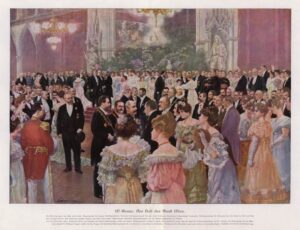
- Der Ball der Stadt Wien, by Wilhelm Gause, 1904. © Wien Museum
-
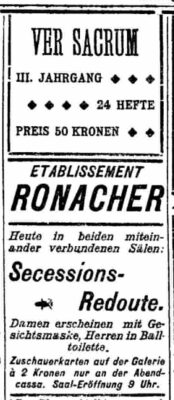
- Advertisement for the Secessions_Redoute. Ver Sacrum Advertisement above. Feb 20, 1900
-
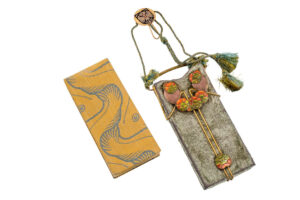
- Ball donation for the Ball of the City of Vienna on 09.02.1901, Koloman Moser, J. Souval Wien, 1901. © Nikolaus Kolhammer Wien
-
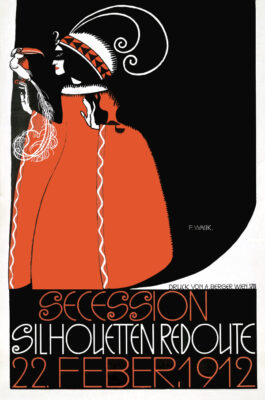
- Franz Wacik, Poster for Secession Silhouetten Redoute, Vienna, Feb. 1912. Wikipedia CC.
-
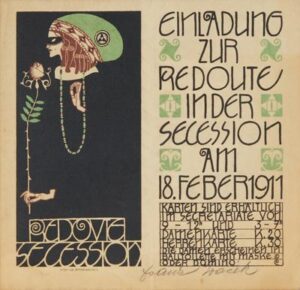
- Franz Wacik, Invitation for ‘Einladung zur Redoute in der Secession am 18. Feber 1911’. © Dorotheum Auction House, Vienna
-
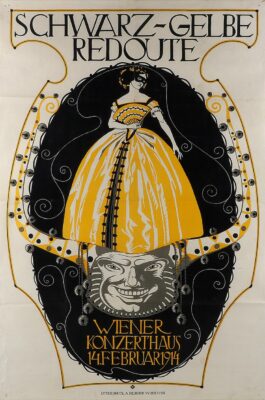
- Franz Wacik, Schwarz-Gelbe Redoute, Wiener Konzerthaus (Schwarz-Gelbe Redoute Wiener Konzerthaus, 1914.) ©Fine Art Images/Heritage Images
-
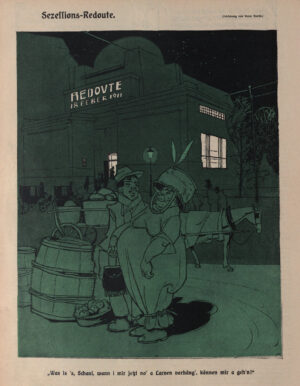
- Illustration by Franz Wacik for the 1911 Redoute from the Magazine ‘Die Muskete’. The caption reads: “What’s up, Schanl, if I put on a mask now, we can go too!”
-
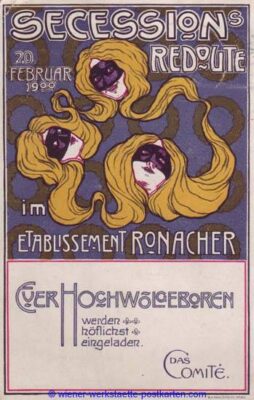
- Postcard for the 1900 Secessions-Redoute. © Wiener-Werkstâtte-Postkarten.com
-
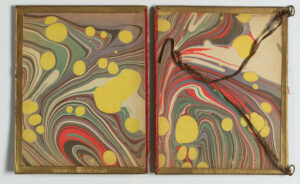
- Ball Souvenir, Concordia Ball 1909 (cover designed by Josef Hoffmann, marbled paper designed by Koloman Moser)1909. © Leopold Museum, Vienna.
-
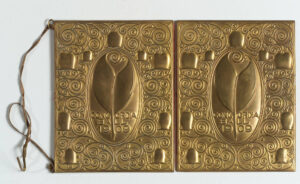
- Ball Souvenir, Concordia Ball 1909 (cover designed by Josef Hoffmann, marbled paper designed by Koloman Moser)1909. © Leopold Museum, Vienna.
-
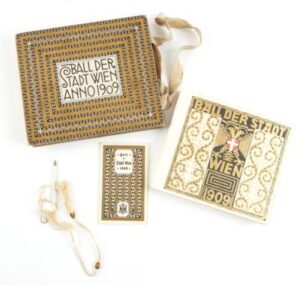
- BALL DER STADT WIEN 1909, with box and book designer by Remigius Geyling. © Dorotheum Auction House, Vienna
-
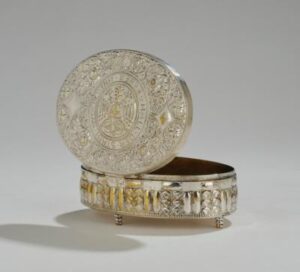
- Ballspende ‘Ball der Stadt Wien Feber 1911’, Remigius Geyling für Wilhelm Melzer, Wien VII © Dorotheum Auction, Vienna
-
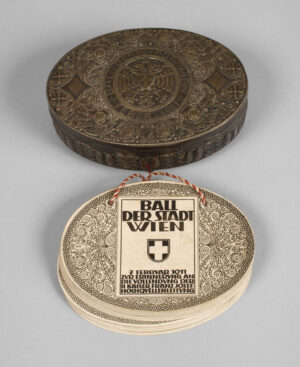
- Remigius Geyling, Ballspende for the ‘BAll der Stadt’, 1911. © Auktionshaus Mehlis GmbH
-
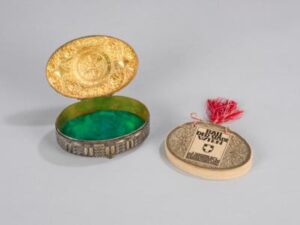
- Ballspende ‘Ball der Stadt Wien Feber 1911’, Remigius Geyling für Wilhelm Melzer, Wien VII_Booklet. © Dorotheum Auctions Vienna
-
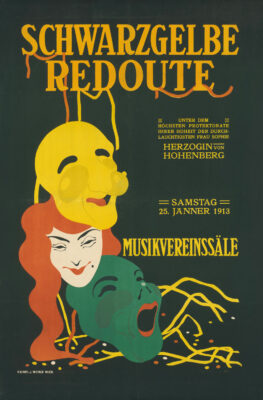
- Künstler unbekannt, Schwarzgelbe Redoute. Musikvereinssäle, 1913, Staatliche Museen zu Berlin, Kunstbibliothek : Dietmar Katz (Public Domain Mark 1.0)
-
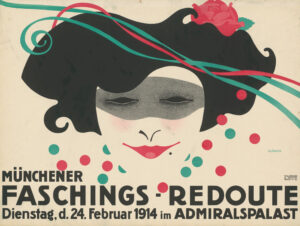
- Julius Klinger, Münchener Faschings-Redoute, 1913, Staatliche Museen zu Berlin, Kunstbibliothek : Dietmar Katz (Public Domain Mark 1.0)
-
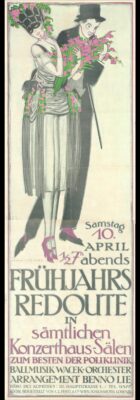
- Poster by Bernd Steiner (1884-1933) – Frühjars Redoute Wien. © Van Sabben Poster Auctions
-
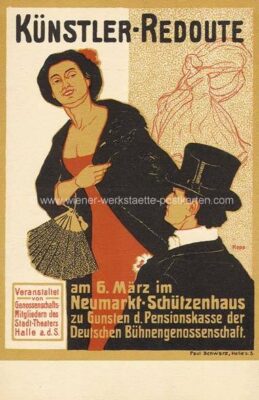
- Kopp, Halle Künstler-Redoute um 1910 © Wiener-werkstatte-postkarten.com
-
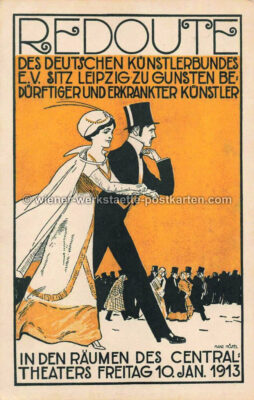
- Leipzig Künstler Redoute – 1914. © Wiener-werkstatte-postkarten.com
-
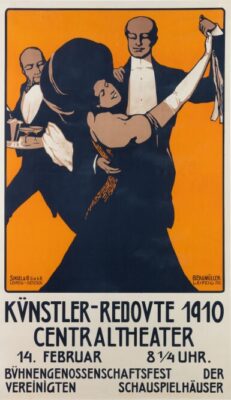
- Karl Bergmüller Künstler Redoute Centraltheater, 1910. © Sotheby’s Auctions
-
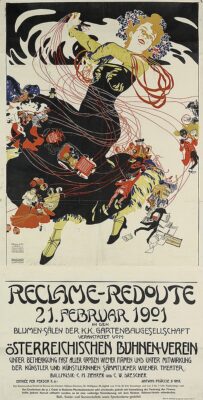
- ERWIN PUCHINGER (1875-1944). RECLAME – REDOUTE. 1901. © Swann Galleries
-
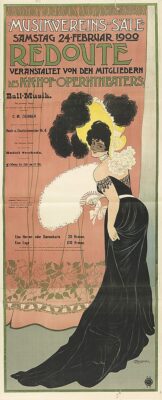
- EMIL RANZENHOFER, MUSIKVEREINS/ REDOUTE. 1900. © Swann Galleries
-
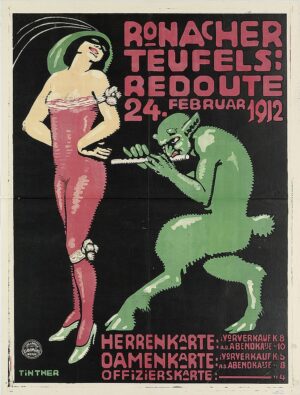
- ERWIN TINTNER (1885-1957). RONACHER TEUFELS : REDOUTE. 1912. © Swann Galleries
-
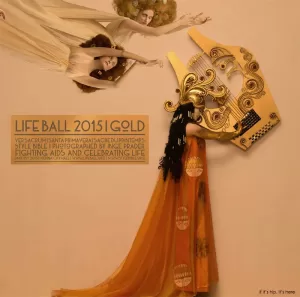
- In 2015, photographer Inge Prader reimagined the opulent world of Gustav Klimt for Vienna’s annual Life Ball